Mitä taiteilijoille tapahtuu heidän vanhetessaan?
Kalasataman urbaanin kerrostalomaiseman keskellä, entisellä satama- ja teollisuusalueella Helsingissä, sijaitsee rakennus, joka näyttää ulospäin melko tavanomaiselta uudelta kerrostalolta. Sisällä tapahtuu kuitenkin jotakin, mikä tuntuu nykytaidemaailmassa yhä harvinaisemmalta: taiteilijat vanhenevat yhdessä — jatkaen samalla työskentelyään.
Ars Longa ei ole residenssi eikä seniorikoti. Se on vuonna 2020 valmistunut asuintalo yli 55-vuotiaille ammattitaiteilijoille, kirjailijoille ja muotoilijoille. Rakennuksen toteuttivat yhteistyössä Suomen Taiteilijaseuran Ateljeesäätiö, Ornamo sekä Suomen Kirjailijaliitto. Talossa on 56 esteetöntä asuntoa sekä yhteisiä tiloja: kaksi saunaa, pieni kirjasto, kuntosali, yhteinen tapahtumatila ja kattoterassi, jossa kasvatetaan kukkia, yrttejä ja vihanneksia Helsingin taivaan alla.
Talon vanhimmat edelleen aktiivisesti työskentelevät taiteilijat ovat 85-vuotiaita.
Nykytaiteen kenttä rakentuu usein uuden ympärille: uusien nimien, uusien löytöjen. Taiteilijan elämä alkaa helposti näyttäytyä sarjana pieniä näkyvyyden hetkiä. Mutta mitä tapahtuu niiden ulkopuolella? Mitä tapahtuu kun uudet nimet, löydöt ja niiden ulkopuolelle jäävät vanhenevat? Mitä tapahtuu vuosikymmenten mittaiselle työskentelylle? Mitä tapahtuu teoksille, luonnoksille, ideoiden arkistoille ja teosvarastoille? Mitä tapahtuu ihmiselle, jonka koko elämä on rakentunut taiteen tekemisen ympärille?
Ars Longassa nämä kysymykset eivät ole vain teoreettisia.
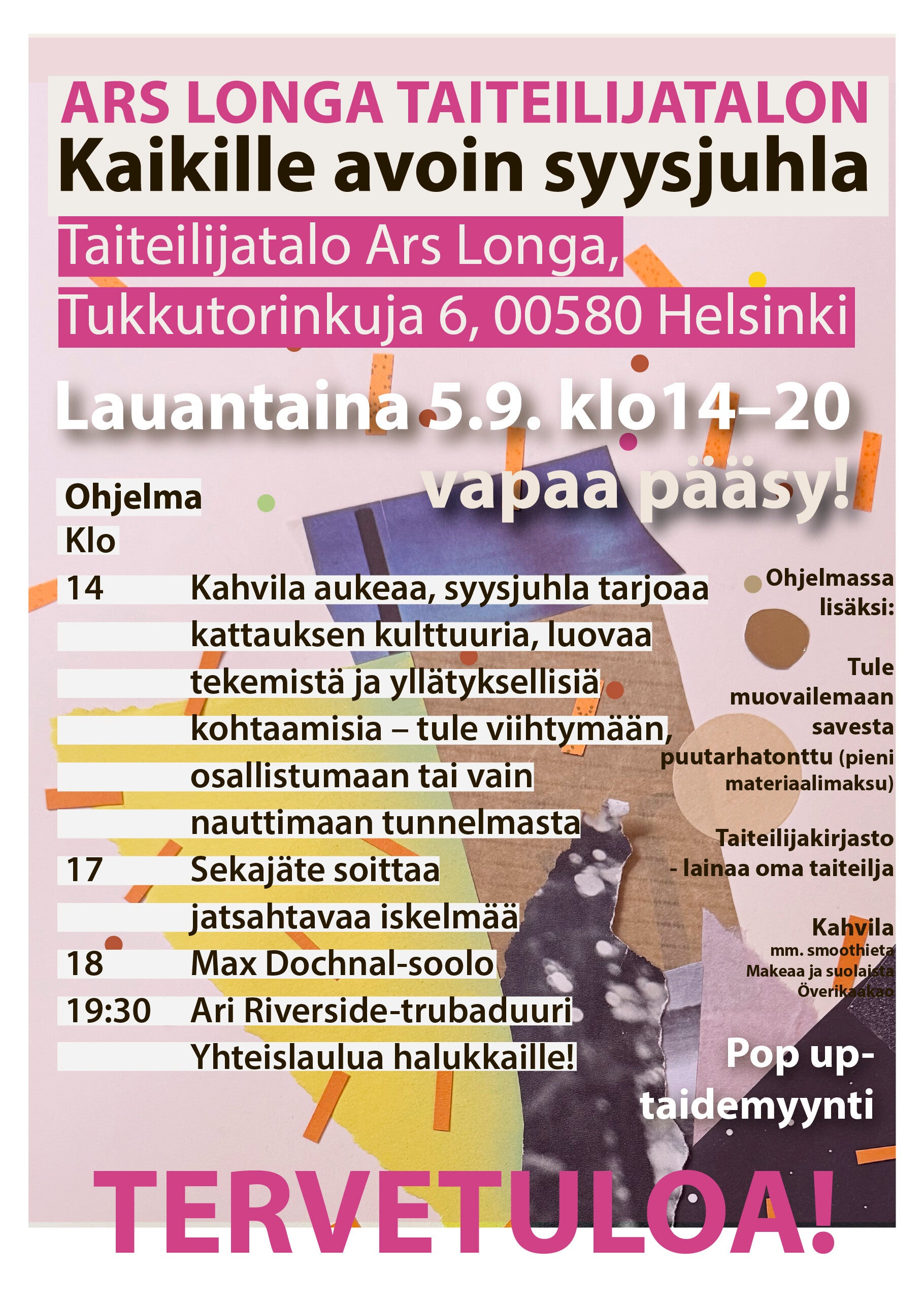
Talossa asuu kuvataiteilijoita, kirjailijoita, muotoilijoita, elokuvantekijöitä ja performanssitaiteilijoita. Yhdessä he ylläpitävät Galleria Longaa ja ikkunagalleria Fönaria sekä järjestävät näyttelyitä, keskusteluja, esityksiä, elokuvailtoja ja yhteisöllisiä tapahtumia Ars Longa -talon taiteilijat ry kautta.
Toiminta rakentuu jatkuvuudelle: ajatukselle siitä, että taiteellinen työ voi jatkua myös silloin, kun näkyvyys, työelämän rakenteet ja yhteiskunnan huomio alkavat siirtyä muualle. Ja silloinkin, kun fyysiset voimat alkavat heiketä.
Samalla Ars Longassa on alettu keskustella yhä konkreettisemmin taiteilijoiden elämäntyön säilyttämisestä. Mitä tapahtuu teoksille taiteilijan kuoleman jälkeen? Kuinka paljon taidehistoriaa katoaa varastoihin, ullakoille, kuolinpesiin tai pahimmillaan kaatopaikoille?
Kysymykset tuntuvat polttavilta juuri nyt. Yhteiskunta tarjoaa edelleen hyvin hauraita rakenteita taiteilijan koko elämän mittaiselle työskentelylle. Asuminen, pienituloisuus, sairaudet, vanheneminen ja arjen ylläpitäminen jäävät helposti taidemaailman näkyvien kertomusten ulkopuolelle, vaikka juuri ne muovaavat jokaisen taiteilijan työskentelyä ja elämää.
Ars Longa syntyy samasta historiasta kuin monet taiteilijavetoiset tilat: niukkuudesta, vapaaehtoistyöstä, institutionaalisista aukoista ja tarpeesta rakentaa itse sellaisia rakenteita, joita ei vielä ole olemassa. Mutta samalla se ehdottaa jotakin muuta: mahdollisuutta pitkäkestoisempaan jatkuvuuteen.
Rakennuksen sisällä arki ja taiteellinen työ sekoittuvat toisiinsa lähes huomaamatta. Hississä kulkevat samaan aikaan rollaattorit, maalaukset, videoprojektorit ja installaatiomateriaalit. Saunakeskustelut ja käytäväkohtaamiset muuttuvat näyttelysuunnitteluksi. Talon gallerian avajaiset juhlistavat ja rytmittävät arkea kolmen viikon välein.
Aikana, jolloin saavutettavuus, yhteisöllisyys ja hoiva muuttuvat helposti kulttuuri-instituutioiden ohjelmallisiksi teemoiksi, Ars Longassa ne ovat osa jokapäiväistä rakennetta. Ei retoriikkana vaan elettynä infrastruktuurina.
Ehkä taiteellisen elämän tulevaisuus ei riipu vain uusien taiteilijoiden löytämisestä, vaan siitä, pystymmekö rakentamaan sellaisia rakenteita, joissa taiteilijoiden annetaan pysyä näkyvinä riittävän kauan vanhetakseen.
Iina Kuusimäki,
taiteilija-kuraattori
puheenjohtaja Ars Longa -talon taiteilijat ry
What happens to artists as they grow old?
In the middle of Kalasatama’s urban landscape, on a former harbor and industrial site in Helsinki, stands a building that outwardly resembles a fairly ordinary contemporary apartment block. Inside, however, something is taking place that feels increasingly rare in the contemporary art world: artists are growing old together — while continuing to work.
Ars Longa is neither a residency nor a retirement home. Completed in 2020, it is a residential building for professional artists, writers, and designers over the age of 55. The building was developed collaboratively by the Ateljé Foundation of the Finnish Artists’ Association, Ornamo Art and Design Finland, and the Union of Finnish Writers. It contains 56 apartments alongside shared spaces including two saunas, a small library, a gym, a communal event space, and a rooftop terrace where flowers, herbs, and vegetables are grown beneath the Helsinki sky.
The oldest actively working artists in the building are now 85 years old.
The contemporary art world is often structured around the new: new names, new discoveries. An artist’s life can easily begin to appear as a sequence of small moments of visibility. But what happens outside them? What happens when new names and discoveries age — and those left outside. What happens to decades of artistic work? What happens to artworks, sketches, archives of ideas, and storage spaces filled with work? What happens to a person whose entire life has been built around the making of art?
In Ars Longa, these questions are not only theoretical.
The building is home to visual artists, writers, designers, filmmakers, and performance artists. Together they run Galleria Longa and the window gallery Fönari through the residents’ association Ars Longa House Artists Association, organizing exhibitions, discussions, performances, screenings, and community events throughout the year.
The activity emerging from Ars Longa is built around continuity: the idea that artistic work can continue even when visibility, institutional structures, and society’s attention begin to move elsewhere — and even when the artist's physical strength fades with age.
At the same time, conversations within Ars Longa have increasingly turned toward the preservation of artists’ life work. What happens to artworks after an artist dies? How much art history disappears into storage units, attics, family homes, or, in the worst cases, landfills?
These questions feel increasingly urgent. Society still offers remarkably fragile structures for sustaining artistic work across an entire lifetime. Housing, low income, illness, ageing, and the maintenance of everyday life often remain outside the visible narratives of the art world, even though they shape every artist’s working life and existence.
Ars Longa emerges from the same history as many artist-run spaces: scarcity, volunteer labour, institutional gaps, and the need to build structures that do not yet exist. But at the same time, it proposes something else: the possibility of longer continuity.
Inside the building, everyday life and artistic work merge almost unnoticed. Rollators, paintings, video projectors, and installation materials travel together in the lift. Sauna conversations and encounters in the hallways turn into exhibition planning. Exhibition openings in the building’s gallery frame and celebrate everyday life every three weeks.
At a moment when accessibility, community, and care are increasingly treated as thematic programming within cultural institutions, in Ars Longa they are embedded into the building’s daily structure. Not as rhetoric, but as lived infrastructure.
Perhaps the future of artistic life depends not only on discovering new artists, but on whether we are capable of building structures in which artists are allowed to remain visible long enough to grow old.
Iina Kuusimäki
artist-curator
chairperson of Ars Longa House Artists Association